
UNITEN (UNIVERSITY TENAGA NASIONAL) • MALAYSIA
Putrajaya • Intakes: Jan, July, Sept • MALAYSIA
Tuition
RM 98,000
Duration
3 Years
Intake
Intakes: Jan, July, Sept
Faculty
college of engineering coe
Scholarship
Ask us about available waivers and aid
Mode of Study: Full Time (Yes) | Part Time (No)
This syllabus has been designed to meet the requirements of professional bodies and industries while giving students the competitive edge. Emphasis is on the application of knowledge through teamwork, case studies, simulations and real-life projects.
The Bachelor of Electrical & Electronics Engineering (Hons) programme is designed to prepare you for professional career and higher advancement in the area of communication, electronics, computers, control systems, signal processing, power engineering and other related areas. The curricula for this undergraduate programme requires a strong foundation in mathematics, calculus, physics, computer literacy, and programming.
During the final year, you are free to choose several topics from technical electives, to specialise deeper in an area of your interest. You may choose to streamline to a particular options grouping. Design project courses (Integrated Design Project and Final Year Project) offered in the final year will aid you in gaining experience of current technology and equipment usage as well as provide opportunities to apply engineering principles that you have acquired earlier on, and even further advance into investigative research.
A total 138 credit hours of subjects are being taught in 8 semesters. This Bachelor of Electrical & Electronics Engineering (Hons) programme can be completed in 4 years.
Programme Highlights
Summary of BEEE Programme Educational Objectives (PEO)
| PEO No. | Programme Educational Objectives |
| UNITEN produces Electrical & Electronics engineering graduates who: | |
| PEO1 | Are practicing engineers in electronics or energy related business |
| PEO2 | Hold leadership responsibilities and/or have established their own enterprise |
| PEO3 | Have professional qualifications/ certifications in electronics engineering related areas |
| PEO4 | Engage in activities to enhance knowledge in their work |
BEEE Programme Outcomes (PO)
| Programme Outcomes | |
| Students graduating from the Bachelor of Electrical & Electronics Engineering (BEEE) programmes will have the ability to: | |
| PO No. | PO Statements |
| PO1 | Apply knowledge of mathematics, natural science, computing and engineering fundamentals, and an engineering specialization as specified in WK1 to WK4 respectively to develop solutions to complex engineering problems |
| PO2 | Identify, formulate, research literature and analyze complex engineering problems reaching substantiated conclusions using first principles of mathematics, natural sciences and engineering sciences with holistic considerations for sustainable development |
| PO3 | Design creative solutions for complex engineering problems and design systems, components or processes to meet identified needs with appropriate consideration for public health and safety, whole-life cost, net zero carbon as well as resource, cultural, societal, and environmental considerations as required |
| PO4 | Conduct investigation of complex engineering problems using research methods including research-based knowledge, design of experiments, analysis and interpretation of data, and synthesis of information to provide valid conclusions |
| PO5 | Create, select and apply, and recognize limitation of appropriate techniques, resources, and modern engineering and IT tools, including prediction and modelling, to complex engineering problems |
| PO6 | Analyze and evaluate sustainable development impacts* to: society, the economy, sustainability, health and safety, legal frameworks, and the environment, in solving complex engineering problems |
| PO7 | Apply ethical principles and commit to professional ethics and norms of engineering practice and adhere to relevant national and international laws. Demonstrate an understanding of the need for diversity and inclusion |
| PO8 | Function effectively as an individual, and as a member or leader in diverse and inclusive teams and in multidisciplinary, face-to-face, remote and distributed settings |
| PO9 | Communicate effectively and inclusively on complex engineering activities with the engineering community and with society at large, such as being able to comprehend and write effective reports and design documentation, make effective presentations, taking into account cultural, language, and learning differences |
| PO10 | Apply knowledge and understanding of engineering management principles, economic decision-making, entrepreneurship, and apply these to one’s own work, as a member and leader in a team, and to manage projects in multidisciplinary environments |
| PO11 | Recognize the need for and have the preparation and ability for i) independent and life-long learning ii) adaptability to new and emerging technologies and iii) critical thinking in the broadest context of technological change |
What You'll Learn
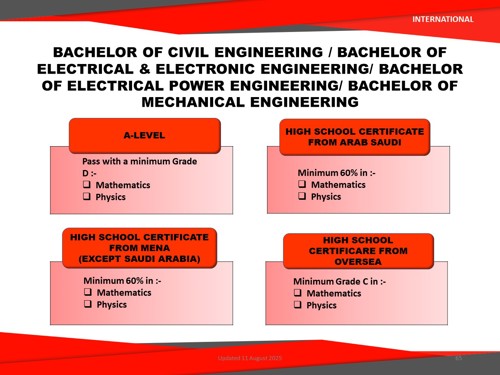
For International Student
English Requirement
International Students
International students are required to fulfil one of the English proficiency scores stated below to enrol at UNITEN. Foundation students who do not fulfil this English requirement are required to sit for the Test of English Proficiency (TEP) before they could enrol in the English Short Course (ESC).
- Malaysian University English Test (MUET)
Achieve Band 3 and above
- International English Language Testing System (IELTS)
Achieve 5.0 and above
- Test of English as a Foreign Language (TOEFL)
Achieve 500 (TOEFL) or 42 (TOEFL Internet-Based Test) and above
| Fee Type | Malaysian | International |
|---|---|---|
| Total Tuition Fees | RM 95,000 | RM 98,000 |
| Other Fees (Excluded from Total Tuition Fees) | Registration RM 1,348 | EMGS Application Fee (Visa):
Registration Fee:
Application Fee (upon acceptance of offer): |
| Advanced Semester Fee (Included in Total Tuition Fees) | RM 10,000 | RM 10,000 |
Note: Other Fee type
Accommodation Advance Fee (if applicable) = RM250. Subject to terms and conditions. Other optional fees/charges include Medical Insurance, electricity, parking, English Short Course (ESC), Test of English Proficiency (TEP) and some student facilities within UNITEN.
Flexible payment options are available:
1. Full payment in advance
2. Monthly instalment plans
3. Full payment by two weeks before the semester's final examinations.
STUDENT PASS / VISA REQUIREMENTS (INTERNATIONAL STUDENTS)
All international students who plan to study full-time in Malaysia are required to obtain a Student Pass (Student Visa) before starting their studies.
• You must receive an official Offer Letter from the university before applying for a student pass
• The university will submit your Student Pass application through Education Malaysia Global Services (EMGS) on your behalf
• A Visa Approval Letter (VAL / eVAL) is required before travelling to Malaysia
• Studying on a tourist or social visit visa is not permitted
• Your passport must be valid for at least 18 months from your intended intake date
• Visa processing time depends on EMGS and Malaysian Immigration approval
• After arriving in Malaysia, all students must complete a medical check-up at an EMGS-registered clinic
• Your Student Pass will be issued only after medical clearance and document verification
• Continuing students must renew their Student Pass before it expires
DOCUMENTS REQUIRED FOR STUDENT PASS APPLICATION
The following documents are commonly required for all international students:
• Valid passport (clear scanned copy of all pages, including blank pages)
• Passport-size photograph with a white background
• Official Offer Letter from the university
• Academic certificates and transcripts related to your programme
• English language proficiency certificate (IELTS / TOEFL or equivalent), if required
• Proof of acceptance or tuition fee payment (if requested by the university)
• Student Pass / Visa processing fee as determined by EMGS
• Completed EMGS Health Declaration Form (if applicable)
Please note: All documents not originally in English must be submitted together with certified English translations.
ADDITIONAL DOCUMENTS (IF APPLICABLE)
Some students may be asked to provide extra documents depending on their situation:
• Release Letter and Visa Cancellation Letter (for students transferring from another institution in Malaysia)
• School Leaving Certificate (for foundation or diploma applicants)
• Sponsorship or Scholarship Letter (if your studies are funded)
• Proof of financial support to cover tuition fees and living expenses
• Statutory Declaration (if there are name differences across documents)
• Resume or Character Reference Letter (commonly required for applicants above 23 years old)
• Police Clearance Certificate (if requested by EMGS or embassy authorities)
• Copy of previous Malaysian visa or Resident Pass (if applicable)
AFTER ARRIVING IN MALAYSIA
Once you arrive in Malaysia, you will need to:
• Complete a medical examination at an EMGS-approved clinic
• Submit your passport for Student Pass endorsement
• Receive a temporary Special Pass (if applicable) while your Student Pass is being processed
• Collect your Student Pass and complete university registration
IMPORTANT REMINDERS
• Student Pass requirements are set by Malaysian Immigration and EMGS and may vary by nationality
• The university’s International Office will guide you through each step of the process
• Students are strongly advised to prepare documents at least 2–3 months before intake
• Requirements may change, so always follow the latest instructions provided by the university
| Year | Fee |
|---|---|
| 1st Year | RM 36,750 |
| 2nd Year | RM 36,750 |
| 3rd Year | RM 24,500 |
| Description | Fee |
|---|---|
| Other fees will be shared during advising. | |